

A head scratcher (yes, please!)
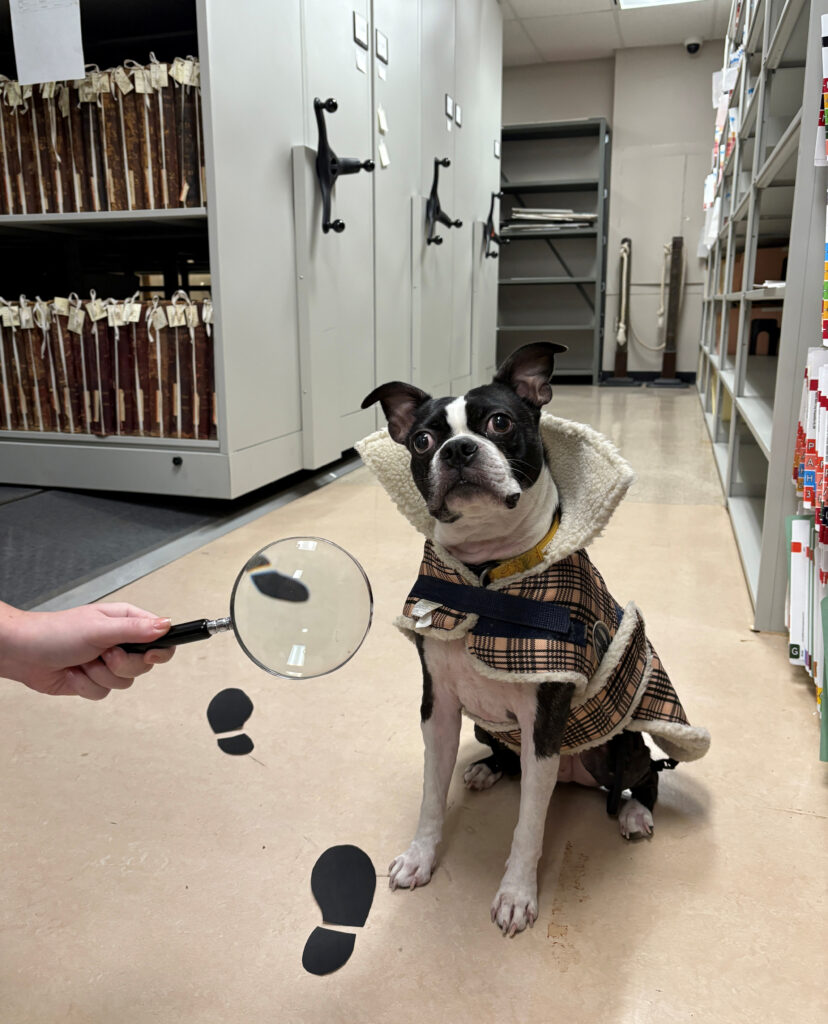
As the Corporate Archives’ resident Barkivist, I’m always on the case for a good head scratcher. Luckily, BMO employees in the 1940s and 1950s liked to stay sharp by challenging each other to brain teasers. In honour of National Puzzle Day, I dug up some brain teasers from our 1948 Staff Magazines. Call me Bones, Sherlock Bones.
P.S. The Corporate Archives team tried their hand at these and couldn’t solve them all. Even I couldn’t throw them a bone to help!
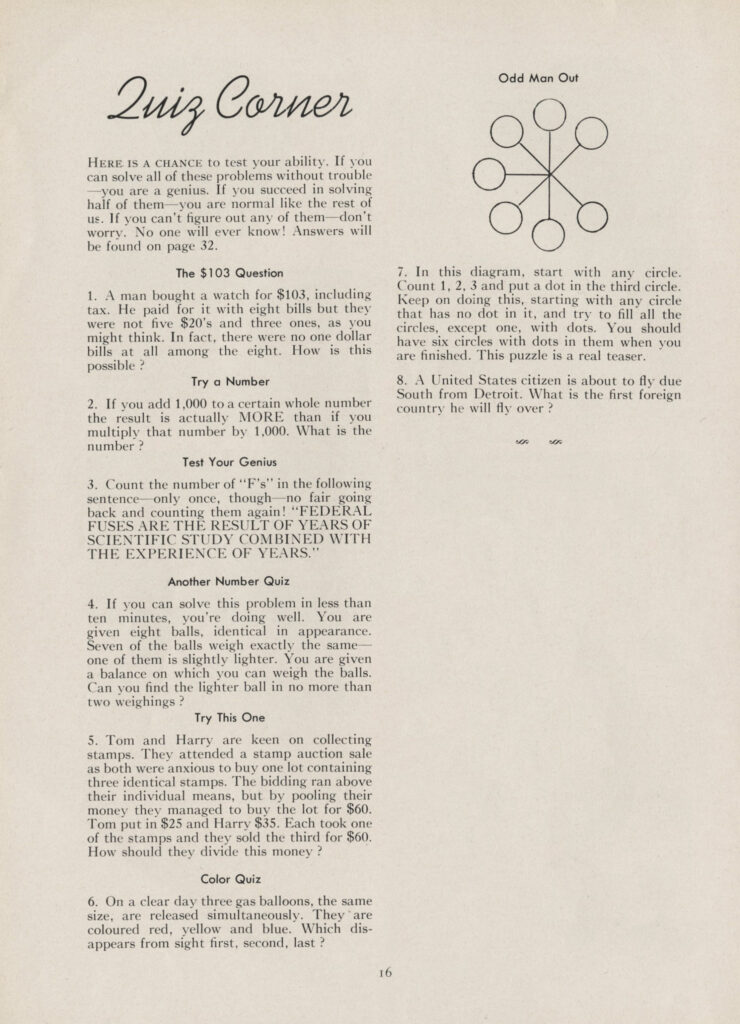
Quiz Corner
Here is a chance to test your ability. If you can solve all of these problems without trouble – you are a genius. If you succeed in solving half of them, you are normal like the rest of us. If you can’t figure out any of them – don’t worry, no one will ever know
The $103 Question
1. A man bought a watch for $103, including tax. He paid for it with eight bills but they were not five $20’s and three ones, as you might think. In fact, there were no one dollar bills at all among the eight. How is this possible?
Try a number
2. If you add 1,000 to a certain whole number, the result is actually MORE than if you multiply that number by 1,000. What is the number?
Test Your Genius
3. Count the number of “F’s” in the following sentence – only once, though – no fair going back and counting them again! “FEDERAL FUSES ARE THE RESULT OF YEARS OF SCIENTIFIC STUDY COMBINED WITH THE EXPERIENCE OF YEARS.”
Another Number Quiz
4. If you can solve this problem in less than ten minutes, you’re doing well. You are given eight balls, identical in appearance. Seven of the balls, weigh exactly the same – one of them is slightly lighter. You are given a balance on which you can weigh the balls. Can you find the ball in no more than two weighings?
Try This One
5. Tom and Harry are keen on collecting stamps. They attended a stamp auction sale as both were anxious to buy one last lot containing three identical stamps. The bidding ran above their individual means, but by pooling their money they managed to buy the lot for $60. Tom put in $25 and Harry $35. Each took one of the stamps and they sold the third for $60. How should they divide this money?
Color Quiz
6. On a clear day, three gas balloons, the same size, are released simultaneously. They are coloured red, yellow, and blue. Which disappears from sight first, second, last?
Odd Man Out
7. In this diagram, start with any circle. Count 1, 2, 3 and put a dot in the third circle. Keep on doing this, starting with any circle that has no dot in it, and try to fill all the circles, except one, with dots. You should have six circles with dots in them when you are finished. This puzzle is a real teaser.
8. A United States citizen is about to fly due South from Detroit. What is the first foreign country he will fly over?
Answers to Quiz Corner
1. The man paid for the watch with eight bills as follows: – One $50, two $20’s, one $5, and four $2’s.
2. The number is 1.
3. Figured out the answer? Well, there are really six “F’s” in the sentence.
4. Remove two balls and put three balls on each tray. If the six balls balance you know one of the two is light; then you simply weigh the two. If the six balls do not balance take just the lighter three. Put one ball on each side and hold the third. If the two you are weighing balance, you are holding the light one. If they don’t balance, well there it is!
5. As they paid $60 for the stamps each would be worth $20. By this ratio Tom would have $5 of invested capital and Harry $15. In that way, Tom gets $15 and Harry takes $45.
6. Blue, red, yellow.
7. Always start from the circle that is two away from the circle you previously started with. In other words, put the next dot in the circle that you previously started from.
8. Canada.